Platform
 Solutions
 Owners
 Contractors
 Engineering/EPCM
 Professional Services
 Resources
 White Papers
 Case Studies
 Blog
Blog Videos
 Frequently Asked Questions
 Company
 About
AboutRead In 10 Minutes
When Spreadsheets Become The Problem
For decades, Excel has been the default tool for managing construction projects. Teams rely on spreadsheets for everything from forecasting and cost tracking to procurement logs, progress reporting, labor management, change orders, and countless other project controls.
On the surface, spreadsheets seem like an obvious choice: flexible, affordable, and familiar. But as projects grow and complexity increases, a pattern emerges across the industry:
Excel isn’t helping projects move faster. It’s holding them back.
What works well enough for a handful of jobs can quickly become a serious operational bottleneck when an organization is juggling dozens, or even hundreds, of active projects at once. Add to that the fact that each project is large and complex, with many moving parts and significant financial risk. Version conflicts, manual data entry, broken formulas, and siloed information compound with every new job added to the pile.
The hard truth is that spreadsheets were never built for this. They were designed for data analysis, not for managing the dynamic, fast-moving demands of modern construction project controls.
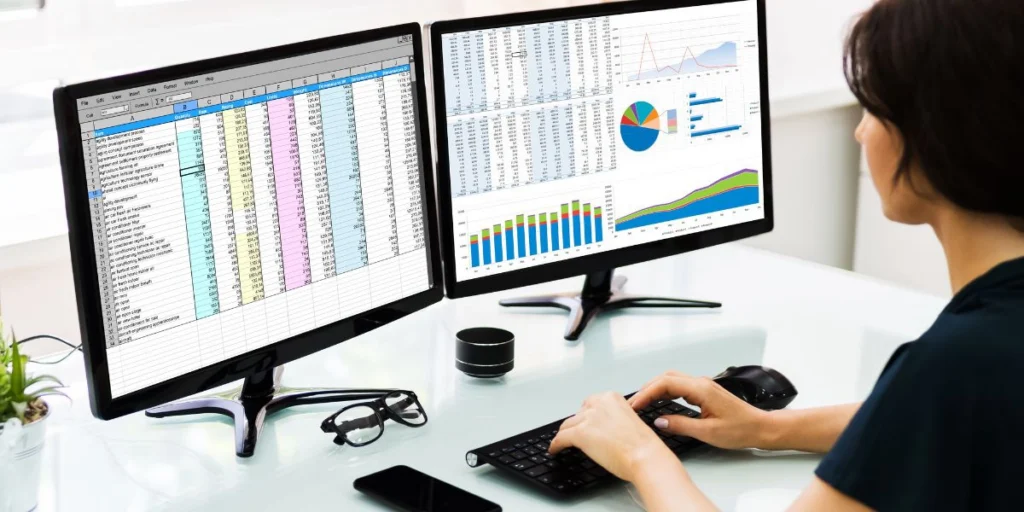
The Hidden Risks of Spreadsheet-Based Project Management
Excel still has its place: quick calculations, one-off analysis, pivoting data, a scratch pad for back-of-napkin math. But building your entire project management foundation on spreadsheets is a different matter entirely. For construction organizations managing real complexity, it creates more problems than it solves.
1. Multiple Versions of the Truth
Without a centralized data source, everyone is working from a different version of the truth.
Project controls teams maintain their own forecast. Finance tracks different numbers. Procurement keeps separate commitment logs. Project managers run their own spreadsheets entirely. Each team believes their data is correct — and none of them are looking at the same thing.
The result is predictable: conflicting reports, finger-pointing, and hours burned reconciling numbers that should have matched in the first place.
Common frustrations include:
- “Which report is correct?”
- “Why do finance and operations have different numbers?”
- “We spend more time updating spreadsheets than analyzing performance.”
When teams cannot trust the data, decision-making slows down and project risk increases.
2. Delayed Visibility into Project Performance
Construction projects don’t wait. Costs shift, schedules slip, labor productivity fluctuates, and procurement commitments change, sometimes all in the same day.
Spreadsheets can’t keep up. Every update requires someone to manually gather the data, enter it, verify it, and distribute it, a process that introduces delays at every step. By the time a report reaches a decision-maker, the numbers it contains may already be out of date.
By the time leadership receives a report:
- The data may already be outdated
- Budget overruns may have worsened
- Schedule delays may have expanded
- Margin erosion may already be occurring
Without real-time visibility, project teams are forced into reactive management instead of proactive decision-making.
3. Manual Processes Increase Human Error
Spreadsheets run on manual effort, data entry, formula maintenance, copy-pasting between files, and emailing updated versions back and forth.
The margin for error is razor-thin. A single bad formula, a missed commitment, a duplicate entry, or a stale report can cascade into forecasting errors, inaccurate progress measurements, and decisions made on bad data.
As projects grow larger and more complex, these mistakes don’t just become more likely — they become more expensive.
4. Excel Does Not Scale With Growth
There comes a point where the system that got you here can’t take you any further.
A spreadsheet setup that worked fine for ten projects and a lean team starts to buckle under the weight of real scale, multiple offices, hundreds of active jobs, larger contract values, complex procurement workflows, and stakeholders who expect consistent, enterprise-level reporting.
The cracks show up fast: operational bottlenecks, inconsistent governance, and reporting delays that only get worse as the workload grows.
5. Limited Visibility Into Commitments and Forecasting
Perhaps no gap is more dangerous than incomplete visibility into committed costs.
A project manager can look at a spreadsheet and genuinely believe they’re under budget — while outstanding purchase orders, unlogged subcontract commitments, and pending invoices tell a completely different story of Fully Committed Budget. By the time those costs surface, the damage is already done.
This disconnect often leads to:
- Forecast inaccuracies
- Surprise cost overruns
- Margin fade
- Cash flow challenges
- Poor financial decision-making
Without integrated forecasting and commitment tracking, project financial performance becomes difficult to predict confidently.
Why Modern Construction Projects Need More Than Excel
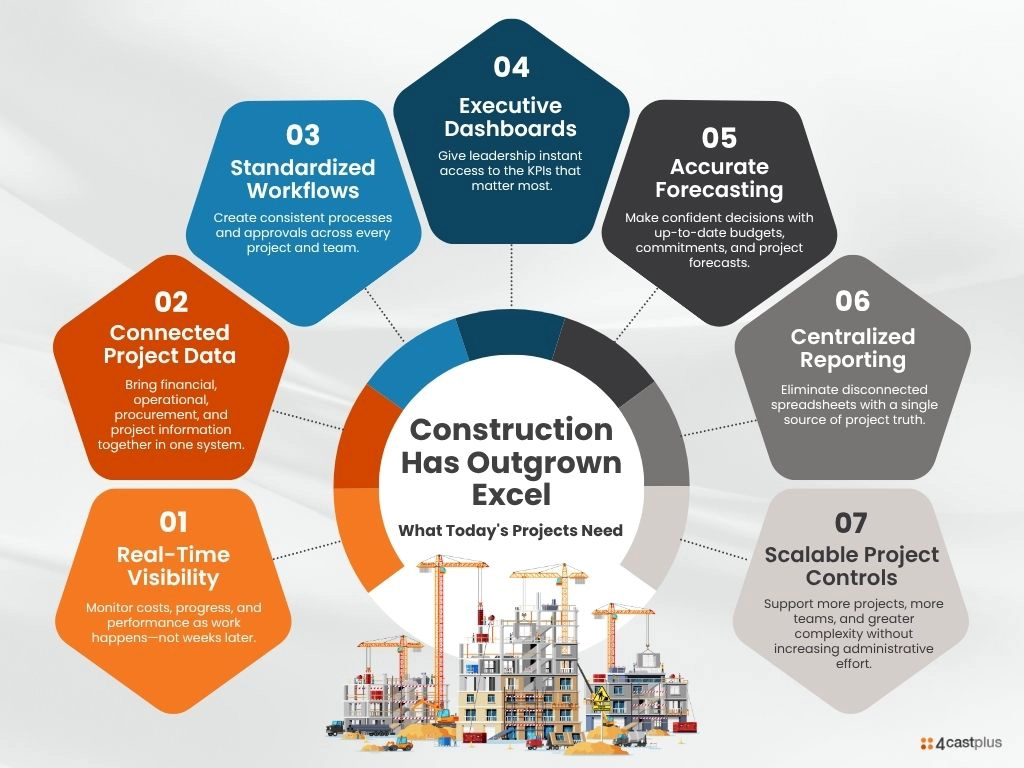
Today’s construction projects require:
- Real-time visibility
- Integrated financial and operational data
- Standardized workflows
- Executive dashboards
- Accurate forecasting
- Centralized reporting
- Scalable project controls
At a certain scale, spreadsheets simply can’t deliver what modern construction demands: the automation, real-time visibility, and cross-team collaboration that keep complex projects on track.
That’s why more construction companies are making the shift to integrated project controls platforms: purpose-built systems that connect project teams, financial data, procurement workflows, forecasting, and reporting in one place — so everyone is working from the same information, at the same time.
Learn More About 4castplus Software
How 4castplus Helps Construction Teams Move Beyond Spreadsheets
4castplus is built specifically for the way construction projects actually work: connecting cost management, forecasting, procurement, project controls, and operational reporting into a single, real-time platform.
No more disconnected spreadsheets. No more chasing down numbers. Just accurate, up-to-date project data where your team needs it, when they need it.
Real-Time Project Visibility
4castplus provides live visibility into:
- Current budgeted costs
- Actual costs
- Committed costs
- Planned value
- Forecast-at-complete
- Labor productivity
- Procurement status
- Project performance trends
This allows project teams to identify risks early and take corrective action before issues escalate.
Integrated Cost Management & Forecasting
Instead of forecasts scattered across a dozen different spreadsheets, 4castplus brings consistency to the process, standardizing how forecasts are built, updated, and reviewed across every project and division.
Teams can:
- Track budgets against actuals in real time
- Monitor commitments and accruals
- Improve estimate-at-completion accuracy
- Reduce manual forecasting errors
- Increase confidence in project financials
Centralized Procurement and Commitment Tracking
4castplus connects procurement directly to project controls, giving teams a complete, real-time picture of every purchase order, vendor commitment, subcontractor cost, change order, and invoice, all in one place.
Nothing falls through the cracks. Budget surprises become the exception, not the rule.
Executive Dashboards and Portfolio Reporting
Instead of waiting for manually assembled monthly reports, executives get real-time dashboards that surface what matters most: project health, margin trends, risk indicators, forecast accuracy, and overall portfolio performance, all from a single, centralized view.
The information is always current. The decisions can happen sooner.
Scalable Project Controls for Growing Organizations
As construction companies grow, 4castplus scales with them, supporting multi-project environments, multi-office operations, standardized governance, workflow approvals, and enterprise reporting, all with the auditability that complex organizations require.
Processes become repeatable. Institutional knowledge gets codified. And operational consistency stops being something you aspire to — it becomes the baseline.
The Future Of Construction Project Management
Excel will always have a role in construction. But as a foundation for project controls and operational management, spreadsheets have reached their limit, and the cost of holding on is growing.
Tighter margins and more complex projects have made real-time visibility, integrated workflows, and accurate forecasting non-negotiable. These aren’t competitive advantages anymore. They’re the baseline.
Organizations still running on disconnected spreadsheets aren’t just accepting inefficiency; they’re ceding ground to competitors who’ve already made the move to centralized project controls platforms.
The question was never whether spreadsheets create limitations.
It’s how much longer you can afford to ignore them.