Platform
 Solutions
 Owners
 Contractors
 Engineering/EPCM
 Professional Services
 Resources
 White Papers
 Case Studies
 Blog
Blog Videos
 Frequently Asked Questions
 Company
 About
AboutRead In 14 Minutes
From Digital Adoption To Industry Standard
In 2026, construction technology crossed a threshold – no longer a niche experiment but a foundational pillar of how complex industrial, engineering, and construction projects get built and managed. The tools that were once optional add-ons are now mission-critical infrastructure.
Investment across the sector reflects this shift. Cloud-based project controls, AI-powered forecasting, real-time cost tracking, BIM, digital twins, mobile field solutions, and integrated ERP platforms have moved from boardroom conversations into active deployment on job sites and in back offices alike. The drive is clear: better productivity, sharper risk management, and end-to-end visibility across the project lifecycle.
The global construction software market is expanding rapidly as firms shed outdated spreadsheets and fragmented systems for unified, data-driven platforms. AI adoption has been particularly striking; contractors are now routinely turning to it for estimating, bid management, scheduling, forecasting, and reporting, embedding intelligence into what were largely manual workflows just a few years ago.
Challenges remain. Data quality, integration complexity, and uneven implementation maturity continue to slow progress for many organizations. But the direction of travel is unmistakable. The industry has reached a genuine digital tipping point, and the gap between early adopters and laggards is widening. Companies that have committed to construction technology are seeing measurable returns in profitability, efficiency, and the ability to deliver projects predictably on a large scale.

Tools Don't Build Projects. People Do.
Technology alone doesn’t build projects; people do. Even the most sophisticated construction software is only as effective as the teams implementing and using it. Successful digital transformation isn’t just a matter of deploying the right platform; it requires buy-in from project managers, field crews, estimators, and executives alike. Training, change management, and a culture that embraces data-driven ways of working are just as critical as the software itself. Organizations that invest in their people alongside their technology consistently see better adoption rates, cleaner data, and stronger returns on their software investment. In an industry where relationships, experience, and judgment still drive outcomes, the most powerful competitive advantage isn’t the tool, it’s a skilled, connected team empowered to use it well.
Collaboration Is A Competitive Advantage
Rework Reduction & Cost Avoidance
- Construction rework typically accounts for 5–15% of total project costs (sometimes higher on complex industrial projects).
- Firms using project controls technology report up to 36% reduction in rework, significantly reducing avoidable cost overruns.
- 75% of contractors report reduced rework after adopting modern construction software platforms.
Impact: Even a small reduction in rework can translate into millions in savings on large capital projects.
Direct Construction Cost Savings
- Digitally mature contractors report double-digit percentage improvements in cost performance, driven by better forecasting accuracy and fewer budget overruns.
- Integrated construction platforms improve cost control by up to ~35%, helping teams identify issues earlier in the project lifecycle.
- Improved field-to-office alignment and real-time data access reduces cost leakage from delays, change mismanagement, and procurement inefficiencies (a major contributor to construction budget overruns across the industry).
Impact: Technology shifts cost management from reactive tracking to proactive financial control.
Scaling Business & Productivity
- Contractors using construction software report being able to manage ~48% more construction volume per person.
- High-adoption firms see significantly improved field productivity, with 88% reporting gains vs. much lower adoption groups.
Impact: Teams scale output without scaling headcount at the same rate.
Efficiency Gains
- Construction technology users report 5+ hours saved per employee per week on administrative and coordination tasks.
- Improved estimating accuracy of ~34% and cost control improvements of ~35% when using integrated digital platforms.
Impact: Less time on manual reporting, more time on execution and decision-making.
Jobsite Safety Improvements
- 83% of optimized tech users report improved job site safety culture after adopting digital tools.
- Safety incidents decrease as visibility improves through real-time reporting, mobile field tools, and better communication loops.
Impact: Technology strengthens safety compliance and proactive risk management.
Overall Industry Shift (2026)
In 2026, construction technology is no longer just a productivity tool—it is a financial control system for projects. The biggest measurable impacts now come from:
- Reduced rework (direct cost avoidance)
- Improved forecasting accuracy (fewer overruns)
- Better labor and resource efficiency (higher output per worker)
- Stronger safety outcomes (fewer incidents and disruptions)
- Scalable operations without proportional overhead growth
One Platform. One Version of the Truth.
One of the most persistent challenges in construction and capital project delivery is the absence of a single, reliable source of truth. When project data lives across disconnected spreadsheets, siloed systems, and countless email threads, teams end up working from different numbers, making decisions on outdated information, and spending valuable time reconciling conflicting reports instead of managing the work.
The scale of this problem is significant. Industry research highlights just how costly fragmented data has become:
- Bad data may have cost the global construction industry $1.85 trillion in a single year, according to a joint study by Autodesk and FMI. Autodesk
- Only 36% of companies share data effectively across departments, while 61% face serious problems as a result of poor data sharing, according to KPMG. Datadrivenconstruction
- 52% of rework is caused by poor project data and miscommunication. Autodesk
- More than $177 billion is lost each year in the U.S. alone due to inefficiencies like rework, time spent searching for data, and communication breakdowns. Trimble
Construction technology solves this by centralizing project data onto a single, integrated platform where everyone, from the field to the back office to the boardroom, is working from the same information in real time. Cost, schedule, progress, forecasts, and documents all live in one place, updated continuously and accessible to the right people at the right time.
The results speak for themselves. Organizations that implement formal strategies to collect, manage, and analyze their data report fewer project delays and budget overruns, less rework, fewer change orders, and reduced safety incidents — turning what was once a fragmented data landscape into a genuine and measurable competitive advantage.
Learn More About 4castplus Software
Time Saved Across The Project Team
Construction technology delivers measurable time savings across every role — from the field to the executive suite. Global research consistently shows that teams using integrated project management platforms spend far less time on non-productive tasks and more time on work that actually moves projects forward.
The Problem: Time Lost to Inefficiency
- 35% of construction work hours — roughly 2.8 hours in an 8-hour day — are spent on non-productive activities including searching for information, resolving conflicts, and managing rework. GoCodes
- Employees spend an average of 1.8 hours every day just searching and gathering information. ArticleCube
- Construction workers lose almost two full working days each week solving avoidable problems. Autodesk
Time Saved By Stakeholder Type
Project & Construction Managers
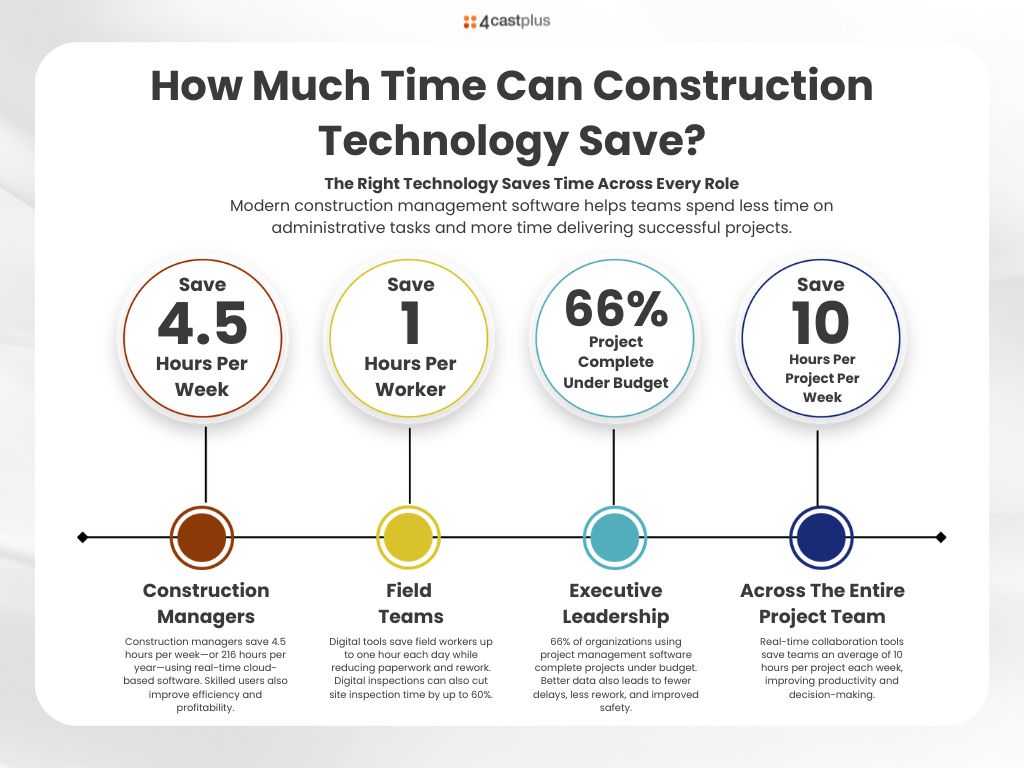
- Construction managers using real-time cloud-based software save an estimated 4.5 hours per week — 216 hours per year. businesswire
- Project management software creates immediate value, with skilled users seeing the greatest gains in efficiency and profitability. Dodge Construction Network
Field Teams & Superintendents
Owners & Executive Leadership
- 66% of businesses using project management software complete their projects under budget. LLCBuddy
- Organizations with formal data strategies report fewer project delays, fewer budget overruns, less rework, and reduced safety incidents. For Construction Pros
All Roles
- The average time saved per project across teams using real-time collaboration tools is estimated at around 10 hours per week. Astuteanalytica
Managing Risk Before It Manages You
In construction and capital project delivery, risk is inevitable, but unmanaged risk is unacceptable. Cost overruns, schedule delays, safety incidents, contractual disputes, and regulatory non-compliance are among the most damaging threats a project can face, and they are far more likely to occur when teams are working without real-time visibility, reliable data, or connected systems. Construction technology fundamentally changes the risk equation by giving project teams the tools to identify, track, and respond to risk proactively rather than reactively. Integrated platforms centralize cost, schedule, safety, and compliance data in one place, enabling early warning signals to surface before small issues become expensive problems. Digital audit trails, automated reporting, and standardized workflows reduce human error and create the accountability structures needed to protect both the project and the business. For owners and contractors managing complex, high-value projects, the ability to forecast risk, model scenarios, and make informed decisions in real time is no longer a competitive advantage — it is a fundamental requirement for project success.
The Future Belongs To The Connected Project
The construction industry is at an inflection point. The evidence is clear: teams that embrace technology, invest in their people, and commit to data-driven ways of working are delivering better projects, managing risk more effectively, and building more resilient businesses. Those that don’t are falling further behind. The question is no longer whether construction technology delivers value; the data proves that it does. The question now is how quickly organizations can close the gap between where they are and where the industry is heading. A single source of truth, real-time visibility, connected teams, and proactive risk management are no longer aspirational goals; they are the new baseline for competitive project delivery. For firms ready to make that commitment, the opportunity is significant. For those who wait, the cost of inaction grows every day.
References
- Procore ROI Report (2022): 75% of users report reduced rework
https://www.businesswire.com/news/home/20220329005335/en/Procores-Annual-ROI-Report-Reveals-Significant-Customer-Benefits-Surrounding-Sustainability-Safety-and-the-Labor-Shortage-in-ConstructionAutodesk Construction Cloud Business Value Report: up to 36% reduction in rework and improved cost control
https://construction.autodesk.com/go/business-value-autodesk-construction-report - NIST Study (Kang et al., 2013): IT adoption correlates with reduced field rework and improved project performance
https://www.nist.gov/publications/interaction-effects-information-technologies-and-best-practices-construction-project
- Autodesk Construction Cloud Report: up to 35% improvement in cost control and financial performance
https://construction.autodesk.com/go/business-value-autodesk-construction-report - BIM ROI research (D3 City project case study): BIM reduced rework-related costs and schedule delays, showing strong ROI impact
https://www.sciencedirect.com/science/article/pii/S0926580511002287 - Systematic review (MDPI, 2023): Digitalisation improves cost control, reduces waste, and supports financial efficiency across project lifecycle
https://www.mdpi.com/2075-5309/13/4/839 - Procore ROI Report (2022): Companies manage ~48% more construction volume per person using construction tech
https://www.businesswire.com/news/home/20220329005335/en/Procores-Annual-ROI-Report-Reveals-Significant-Customer-Benefits-Surrounding-Sustainability-Safety-and-the-Labor-Shortage-in-Construction
- ScienceDirect review (2026): Digital technologies improve labor productivity, coordination, and project delivery speed
https://www.sciencedirect.com/science/article/pii/S0926580526000099 - Procore ROI Report: users save 5+ hours per week per employee on administrative work
https://www.businesswire.com/news/home/20220329005335/en/Procores-Annual-ROI-Report-Reveals-Significant-Customer-Benefits-Surrounding-Sustainability-Safety-and-the-Labor-Shortage-in-Construction
- Autodesk Business Value Report: ~34% improvement in estimating accuracy and workflow efficiency gains
https://construction.autodesk.com/go/business-value-autodesk-construction-report
- Procore ROI Report: 83% of users report improved safety outcomes and safety culture
https://www.businesswire.com/news/home/20220329005335/en/Procores-Annual-ROI-Report-Reveals-Significant-Customer-Benefits-Surrounding-Sustainability-Safety-and-the-Labor-Shortage-in-Construction - MDPI systematic review: digital tools support risk reduction and improved safety monitoring on construction sites
https://www.mdpi.com/2075-5309/13/4/839
- Autodesk & FMI — “Harnessing the Data Advantage in Construction” (2021) https://construction.autodesk.com/resources/guides/harnessing-data-advantage-in-construction/
- KPMG — “Cue Construction 4.0: Time to Make or Break” (2023) https://kpmg.com/xx/en/home/insights/2023/construction-4-0.html
- Autodesk & FMI — “Construction Disconnected” Report (2018) https://www.autodesk.com/blogs/construction/construction-disconnected-fmi-report/
- FMI Corporation / Trimble — Rework & Data Inefficiency (2025) https://www.trimble.com/blog/construction/en-US/article/collaborative-design-sketchup-cut-construction-rework-costs
- Autodesk & FMI — Construction Disconnected (2018) Stat: 35% of work hours spent on non-productive activities / workers lose two full working days per week https://www.autodesk.com/blogs/construction/construction-disconnected-fmi-report/
- McKinsey Global Institute — The Social Economy (2012) Stat: Employees spend 1.8 hours per day searching and gathering information https://www.mckinsey.com/industries/technology-media-and-telecommunications/our-insights/the-social-economy
- Procore / Business Wire — What Gets Measured Gets Managed (2021) Stat: Construction managers save 4.5 hours per week / CAD $446,000 annually per business https://www.businesswire.com/news/home/20210527005338/en/
- Dodge Construction Network — Quantifying the Value of Project Management (2025) Stat: Project management software creates immediate value; skilled users see greatest gains https://www.construction.com/company-news/new-study-project-management-software-for-construction-owners-and-contractors-increases-profitability-productivity-and-efficiency-for-high-skill-users/
- Fieldwire by Hilti — Boost Jobsite Productivity with Construction Management Software (2025) Stat: Field teams save up to one hour per worker per day https://www.fieldwire.com/blog/construction-management-software-productivity/
- Keevee — 64 Construction Industry Statistics (2025) Stat: Drones reduce site inspection time by 60% https://www.keevee.com/construction-industry-statistics
- Autodesk & FMI — Harnessing the Data Advantage in Construction (2021) Stat: Organizations with formal data strategies report fewer delays, overruns, rework, and safety incidents https://construction.autodesk.com/resources/guides/harnessing-data-advantage-in-construction/
- LLCBuddy — Construction Project Management Statistics (2025) Stat: 66% of businesses using project management software complete projects under budget https://llcbuddy.com/data/construction-project-management-statistics/
- Astute Analytica — Construction Software Market Report (2024) Stat: Average time saved per project using real-time collaboration tools is around 10 hours per week https://www.astuteanalytica.com/industry-report/construction-software-market
- Procore ROI Report (2022): 75% of users report reduced rework