Platform
 Solutions
 Owners
 Contractors
 Engineering/EPCM
 Professional Services
 Resources
 White Papers
 Case Studies
 Blog
Blog Videos
 Frequently Asked Questions
 Company
 About
AboutRead In 4 Minutes
Are Unreliable Forecasts Making It Hard to Plan Future Projects?
In the construction industry, accurate project forecasting is essential for controlling costs, meeting deadlines, and preserving profitability. However, despite their significant limitations, many firms still rely on spreadsheets for budget management and cost prediction. Without access to comprehensive historical data and real-time insights, project forecasts often amount to little more than educated guesses—leaving companies vulnerable to cost overruns and financial uncertainty.
If unreliable forecasts undermine your team’s ability to confidently plan future projects, it’s time to reconsider your approach to construction financial management.

The Pitfalls Of Spreadsheet-Based Forecasting
While spreadsheets may appear cost-effective and familiar for construction project forecasting, they harbor significant limitations that frequently lead to inaccurate projections and financial vulnerability. Their simplified approach fails to capture construction projects’ complex variables and interdependencies, potentially undermining your firm’s stability and profitability.
1. Lack of Real-Time Data
Spreadsheets require manual input, meaning they do not automatically update when project costs, material prices, or labor expenses change. This lag in data updates can result in outdated or incorrect forecasts, leading to decisions based on incomplete information.
2. No Access to Historical Trends
One of the biggest challenges with spreadsheet-based forecasting is the inability to access and analyze historical project data quickly. Without previous project costs, productivity rates, and risk factors to reference, forecasts rely on assumptions rather than concrete trends—making them less reliable.
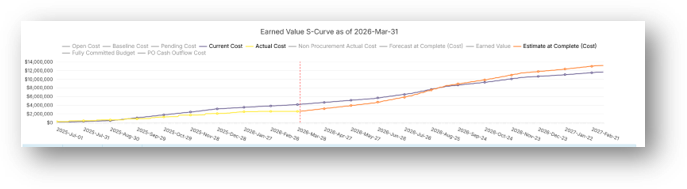
3. Lack of Time-Phased Cash Flow Planning
A forecast is only useful if it shows a cash flow forecast over a timeline. A forecast needs to show much more than just the final cost as a single value – it needs to show the cash flow projections over time, and on a daily basis. Consider the chart below. It shows the original planned cash flow in the blue curve, and the forecasted cash flow in the orange curve.
4. Difficulty In Scenario Planning
Successful construction project forecasting requires analyzing multiple scenarios—best-case, worst-case, and likely outcomes. Spreadsheets are not built for complex “what-if” analysis, making it difficult to predict how changes in labor rates, material costs, or unexpected delays will impact the project.
Learn More About Construction Forecasting
How Data-Driven Forecasting Improves Accuracy
Construction teams need a more advanced forecasting approach that leverages real-time data and historical insights to move beyond guesswork and improve cost predictability. Modern project forecasting solutions offer several key benefits:
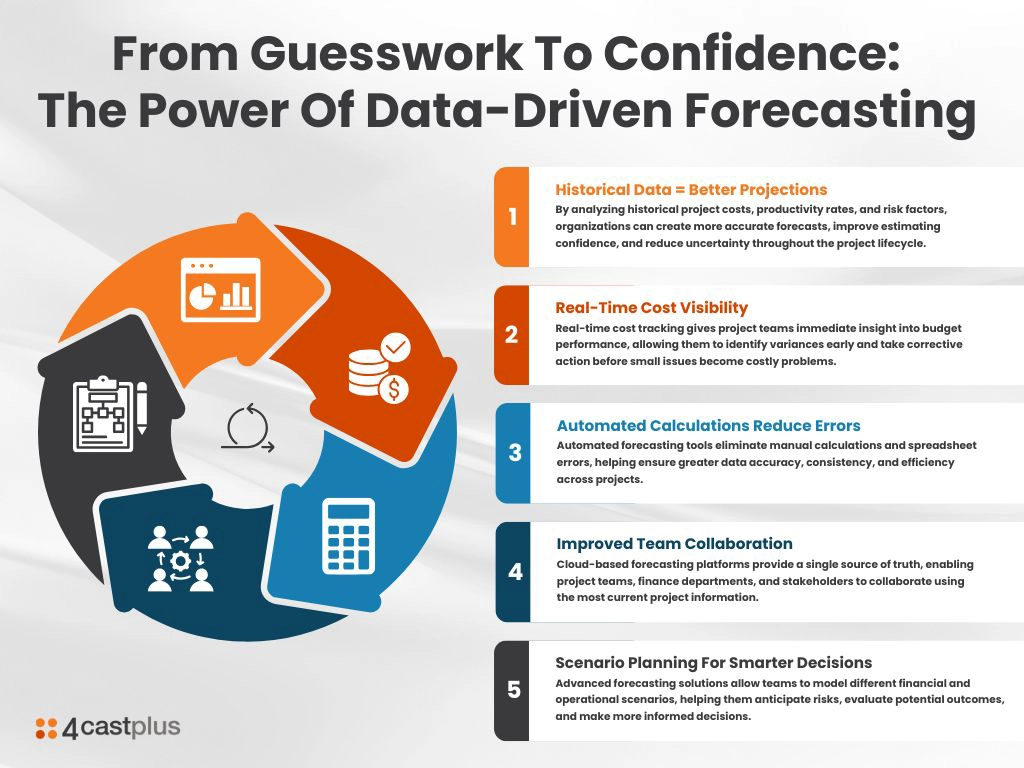
1. Historical Data for More Accurate Projections
Rather than relying on assumptions, integrated forecasting tools use past project data to analyze cost patterns, labor productivity, and risk factors—leading to more precise budget estimates.
2. Real-Time Cost Visibility
Modern construction management software provides real-time tracking of costs, allowing project managers to quickly identify budget deviations and take corrective action before issues escalate.
3. Automated Calculations To Reduce Errors
Unlike spreadsheets, which require manual entry, forecasting software automates calculations, minimizing the risk of human error and ensuring data consistency across projects.
4. Improved Collaboration Across Teams
Cloud-based project forecasting tools enable seamless stakeholder collaboration, ensuring everyone works with the most current data without version control issues.
5. Scenario Planning For Better Decision-Making
Advanced forecasting tools allow project teams to analyze different financial scenarios, helping them prepare for potential risks and make more informed strategic decisions.
The Future of Construction Project Forecasting
Accurate forecasting is more important than ever with rising material costs, labor shortages, and supply chain disruptions. Construction firms that continue to rely on spreadsheets risk falling behind their competitors, who are leveraging modern, data-driven forecasting tools to maintain profitability and financial control.
Transitioning to a purpose-built project forecasting solution can:
✔️Reduce cost overruns
✔️ Improve cash flow management
✔️ Increase project profitability
✔️ Enhance decision-making based on real-time insights
The days of relying on spreadsheets for forecasting are over. If you want to plan future projects confidently, it’s time to adopt a more innovative, more reliable approach.
Are you ready to move beyond guesswork? Investing in a data-driven forecasting solution is the key to staying ahead in today’s competitive construction industry.
References
- https://vitruvisoftware.com/blog/why-managing-construction-projects-with-spreadsheets-is-inefficient
- https://www.pbctoday.co.uk/news/digital-construction/construction-technology-news/excel-spreadsheets/103702/
- https://cmicglobal.com/resources/article/why-are-spreadsheets-an-inadequate-substitute-for-construction-accounting-software
- https://www.constructconnect.com/blog/preconstruction-data-driven-decision-making
- https://gobridgit.com/blog/build-data-driven-culturehttps://www.linarc.com/buildspace/data-analytics-in-construction-management